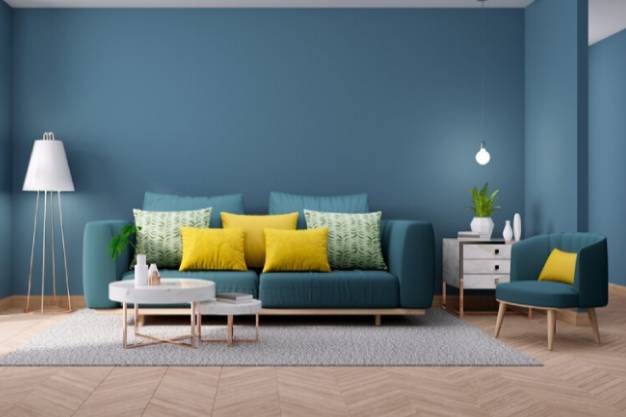
Beat the blues by incorporating navy blue into your home, as it is not only soothing to the eyes, but also adds an air of nonchalance to any room it is used in
Envision this idyllic vision: cloudless summer skies, warm calm sea and a fisherman’s boat sailing across. This picture of nature not only evokes a sense of peace and tranquillity but also positivity and success. Hence, it is no surprise that several studies have revealed navy blue as one of the most calming colours.
According to experts, navy blue is a timeless colour that carries a sense of elegance and sophistication. It is a strong, upright colour that lacks the hard edges and absolutism of black — navy blue commands without being dictatorial. Also, the beauty of navy blue is the elemental colour’s amazing versatility. Much appreciated for its neutrality, weighty presence and classic-meets-comfort sense, this amazing hue adapts to suit most colour schemes and almost all decorating styles.
The colour blue also helps bring down a person’s blood pressure and slows down the respiration and heart rate (seriously!). It sets the mood for a cozy and peaceful environment as well. Therefore, if you are looking to incorporate this deep hue into your home, our experts provide some stylish solutions for the same.
Dress up your home
Keith Menon, co-founder, Spiro Spero, an architecture and a designing company, points out ways to incorporate this soothing colour into your home:
Accent wall: Paint the accent wall of your living or the dining room in navy blue. It will create a statement without being too overwhelming.
Accent pieces: Poufs, arm chairs, rugs, and curtains, are a great way to bring in navy blue. Small pieces of furniture let you create a cohesive look without letting the colour completely take over.
Bedroom: Like other dark colours, navy blue instantly makes a room more intimate and cozy, so it’s a good choice for a bedroom. It can help bring out other design features in your bedroom such as wainscoting, crown moulding and exposed beams. Couple it with crisp, white bed linens and metallic fixtures for balance.
If you want to decorate your home with this comforting yet rich colour – read on what Hemil Parikh, founder, Elysium Abodes LLP – luxury design company has to say:
Navy blue front door: In case you are not sure where to start from, start with the main door! Whether aqua or navy or azure, true-blue doors always appeal to the eye and enhance a home’s appeal.
Classic meets contemporary
Bright splashes of hues and patterns can help in modernising traditional spaces. Patterned navy blue chairs in the living room set off the space as the room’s main focal point. The bold colour can also be featured throughout the room in solid blocks of colour, such as lampshades and throw pillows. A navy blue chest of drawers or side-table can also add a fun pop of colour.
Glam it up: You can make the most of the decadent vibe that dark tones can create by mixing navy blue walls with luxurious materials. Make use of the luxurious velvet fabric on sofas and rugs. They can also be combined with metallic finishes in furniture and accessories to add a greater sense of opulence.
For the balcony: If you have a cute balcony connected to your living room or bedroom, crisp blues are ideal for outdoor decorating. From navy blue painted floorboards to upholstered swings, it will recall the ever-changing shades of surroundings. Navy blue is associated with qualities such as loyalty, trust, peace and success. So, if you are looking to create a distinct look, opt for the all-time favourite and one of the most democratic colours of all time.
Don’t lose sight of…
Make sure that you use navy blue only in the rooms that receive considerable amount of natural light. Navy blue looks best when the sun shines on it;
Try to follow the 60-30-10 rule of design i.e. 60 per cent of the room should be covered in the dominant colour i.e. navy blue; 30 per cent should be doused in the secondary colour and 10 per cent should be an accent;
Pair complementary colours together. For example, blue and green pair together beautifully. White and yellow with blue is a good match as well;
Do not use navy blue in abundance when it comes to large rooms. It can look very overpowering. Instead, try saturated shades like sky blue, light turquoise and the like;
Don’t use dark accents in a room that has navy blue walls;
Do not paint a long wall in a narrow room in navy blue, as this will only make the room look smaller.
There is no doubt about the fact that buying a house is the biggest investment you can make during your lifetime. Besides protecting you from a cold, harsh world and inclement weather conditions, it is your haven of peace. And if you are seeking good luck and prosperity (who isn’t?), then an east facing house is just what you need. At least, that is what the ancient science of Vastu says. Most Indians tend to abide by Vastu principles while purchasing a property. And there is a good reason behind it. Vastu Shastra literally means the science of architecture and it describes in detail the design, layout, directions, and measurements of different spaces. In other words, a home’s direction, layout and other parameters decide to a large extent if it’s going to be good for you. Now, as mentioned before, according to Vastu, an east facing house is highly auspicious. Hence, let’s delve deeper into the various nuances of an east facing house Vastu plan, so that you get your money’s worth for sure.
What Is an East Facing House?
The Vastu direction for an east facing house is determined by the direction of the main door of the house. So, if you are facing the east direction while coming out of the house, then it’s an east facing house. Not only as per Vastu, an east facing house is preferred even from a scientific point of view. As the sun rises in the east, the morning sunlight enters the house, filling the interiors with light, fresh air and positivity. And it’s a widespread belief that good vibes and positive surroundings contribute towards your success.
Benefits of East Facing House
East is the most beneficial direction according to Vastu. Here are some advantages of choosing an east facing house. An east facing house is likely to bring you an abundance of wealth and prosperity. East facing houses are more Vastu compliant than others as these get more natural light in the form of sunlight, which is a source of positive energy. Ideally, there should be some open space outside an east facing house too, as it assures progress in life.
Who Can Live in an East Facing House?
According to Vastu, every property is unique, and every individual is different. So, a thorough evaluation of your horoscope or ‘Kundli’ and your profession should be done to ascertain whether an east facing house is suitable for you. It is generally found that an east facing house is suitable for freelancers or self-employed folks. Moreover, the sun has an influence over the east direction. As per astrology, the sun is associated with professions that involve authority, elegance and power. So, in a nutshell, people who work as government officers, politicians, ministers, entrepreneurs or those who work in creative fields like photography, creative writing, music or dancing are all suitable candidates for an east facing house. Furthermore, as per Vedic astrology, an east facing house is most suitable for people belonging to Aries, Leo and Sagittarius zodiac signs. An east facing house Vastu plan should incorporate the following suggestions for ushering in good vibes and positivity:
The north and north-east corner should be kept clean, sans any dirt, dustbins or clutter.
A wooden nameplate can be placed outside an east facing house.
The north-east zone can be adorned with crystals if a student resides in an east facing house.
You can purify an east facing house with mountain salt for enhancing positive energy and good vibes.
Open spaces should be available on the east side of the house to usher in unhindered sunlight. Not doing so can bring about ill-health including problems during childbirth.
Main Door Placement in East Facing House
To understand a Vastu plan, it’s imperative that you understand a vastu pada. So, imagine that you are dividing the east length of the house in 9 equal parts. Start dividing from north-east corner and extend it to the south-east portion of the house. Each divided part is called a step or ‘pada’. So, the north-east corner becomes the first pada while the south-east corner becomes the last pada. So, accounting for these padas, the main door should be placed in the fifth pada. As per the main door Vastu for east facing house, this placement of the main door can bring you fame and recognition. Avoid placing the main door in the eighth or ninth pada in an east facing house as this can bring about illness. If this main door placement cannot be changed, then Vastu remedial measures need to be applied. Furthermore, if the main door is placed in the fifth pada, a space of about 6 inches should be left from the northeast walls per Vastu, since northeast is the best direction for your home’s entrance.
East Facing House Vastu for Kitchen
As per kitchen Vastu for east facing house, the kitchen should be placed in the south-east direction. Alternatively, a north-west direction kitchen placement is a good choice. However, avoid placing the kitchen in the north, west and north-east directions. The cook should face the east direction in a south-east facing kitchen, while meals should be cooked in the west direction in a kitchen that faces the north-west direction. Moreover, cooking tools and apparatus such as oven, toasters or cooking stove should be placed in the south-east area of the kitchen. As much as possible, the gas cylinder, as well as other cooking equipment and the washbasin, should never be kept on the same platform or parallel to each other in the kitchen. This can cause a negative impact on a person’s behaviour as fire and water are opposing elements. There needs to be a balance between the fire and water elements.
East Facing House Vastu for Dining Room
According to east facing house Vastu, the dining room should follow the kitchen in a continual manner on the east, west or south direction in an east facing house. Moreover, the dining room door should not face the main entrance door. East, north or west side seating arrangement is ideal in the dining area. Although the other family members can sit on the east, west or north side, the family head should always take the east side while being seated for meals. The room should be well ventilated and properly lit with adequate sunlight coming in. Family members should avoid watching television while eating, since this will ensure mindful eating too. The dining table should not be cluttered as it can bar the positive energy from flowing freely.
East Facing House Vastu for Living Room
When the living room is placed in the north east side of an east facing house, it is considered auspicious. Moreover, ensure that the north and east side walls are slightly thinner and shorter than the walls in the west and south sides of the house. Such placements and adjustments help to attract prosperity. The living room should be very bright and have paintings depicting scenery or natural beauty. The living room is an important part of the house and should be set up to exude positivity and foster good relations.
East Facing House Vastu Plan for Pooja Room
As per pooja room east facing house Vastu plan, this room should be in the north-east direction of the house. Moreover, the pooja room ceiling should be lower in comparison to the other rooms in the house. The pooja room should be away from washrooms and should never be adjacent to a bathroom as well. A separate pooja room is always a good idea, but if it is not possible due to space constraints, the temple can be kept in a corner or can be wall mounted. The temple can face any direction in your home except the south. The pooja room or temple should be kept clutter-free too. The idols or photos kept in the temple should not be cracked or broken.
East Facing Vastu House Design for Master Bedroom
As per east facing Vastu direction for house, the master bedroom should face the south-west direction. Moreover, it should be bigger than the other rooms of the house, with the bed facing the west or south wall of the room. As per Vastu, the perfect place to keep the bed is against the south or west wall of the room, so that your head is towards the south or west direction and the legs are in the north or east direction. The bed placement should be such that it does not face the bathroom directly. The bathroom door should be closed always.
Study Room Vastu Plan for an East Facing House
An east or west direction study room is good in an east facing house. North is the next choice of direction for the study room. However, ensure that your study room door should not be adjacent to the study chair. Moreover, there should be some gap left between the study table and the adjacent wall. This allows for energies to be circulated.
Staircase Vastu for East Facing Home
Avoid having a staircase in the north-east corner of an east facing house. The north-west corner or the south-east corner is an ideal place for staircase in an east facing house. The staircase should not be placed in a central location and should wind down in a clockwise direction. Furthermore, no room should be housed under the staircase, though the space can be utilised for storage. Your house should never have a spiral staircase. This kind of staircase is prohibited in Vastu as it is believed to bring evil energy inside the home. It can also have a poor impact on the mental health of the entire family. There should not be any broken steps. The main door should never be in front of the staircase and it should not be directly visible to visitors. The steps of the staircase should be even but not end in a zero.
Indoor Plants for East Facing Home
You might be looking forward to decorating your home with some plants. Indoor greens, when placed in the living room or balcony can freshen up the interiors in a jiffy. However, the following plants will grow well in an east facing home.
Money plant
Neem plant
Holy Basil (Tulsi)
Aloe Vera
Citrus plants such as lemon
Vastu Anomalies in an East Facing House
Be aware of the following Vastu anomalies that might be stopping you from making the most of an east facing house.
If you are facing health problems, strained relations or there is no progress on the work front, then there might be some negative energy in the east direction. It’s quite possible that the stairs, kitchen or washrooms might be placed in the eastern direction of the house.
Outward opening and east facing doors are also counted as Vastu defects in an east facing house. As per Vastu principles, the total number of doors should not be an odd number or have zero as the last digit.
Any clutter in the eastern side of your house can bring in negative energy. So, if you live in an east facing house, maintain a clutter-free and well-ventilated environment.
East Facing House Vastu Tips
Here are some tips to benefit from an east facing house as much as possible.
Keep the north and northeast corners clean and tidy.
Place a wooden nameplate outside an east facing house.
If you have a student living in the house, adorn the northeast zone with crystals.
You can purify an east facing house with mountain salt for enhancing positive energy and good vibes.
Leave open spaces on the east side of the house to ensure unhindered influx of sunlight.
A patio or balcony carved out in the eastern area during the planning stage can help usher in good health and prosperity.
Avoid keeping clutter or garbage in the front area of the plot even during construction as this may block positive energies.
No big trees should grow in the eastern and northern side of the house.
The north-east corner of the house should not have any bedrooms or toilets.
The garage should not be situated in the north-east direction of an east facing house.
You should decorate the main door with auspicious symbols like Om, swastika and draw rangolis at the entrance, as they are said to invite good fortune. Torans can also be hung as decorations.
Realty firm Mahindra Lifespace Developers Ltd on February 10 said it will purchase about 9.24 acres of land in Kandivali, Mumbai from Mahindra & Mahindra Ltd for Rs 365 crore for development of a housing project. Mahindra & Mahindra is the promoter and holding company of Mahindra Lifespace Developers.
This new project will be Mahindra Lifespace’s second residential development in Kandivali after its successful ‘Mahindra Roots’ project and will offer about 1 million square feet of carpet area. The project is expected to be launched in FY23, the company said in a regulatory filing.
The aggregate consideration for this land deal is Rs 365 crore (subject to actual land area survey, deduction of TDS and applicable taxes), to be paid in tranches and interest of 7 percent per annum payable during the interim period of payment on unpaid principal balance from the sale date.
The transaction is at arm’s length, it added.
“Kandivali East is a strategically located, thriving residential hub in Mumbai, and offers well-developed social and civic infrastructure and amenities. This latest land acquisition will help us grow our presence in this high-performing micro-market and is in line with our expansion strategy in Mumbai,” the company’s MD and CEO Arvind Subramanian said.
Rajeev Goyal, CFO, Auto and Farm Sectors, Mahindra & Mahindra Ltd, said the company has got an opportunity to monetise an unused land parcel, which is less than 10 percent of its entire land holding in Kandivali.
He said this will not have any impact on the operations of the company as no operations of its auto and farm verticals are carried out on the land being sold.
The closing of the transaction is subject to related-party approval from shareholders of Mahindra Lifespace Developers Ltd and other statutory approvals.
Sitting on a huge cash pile, Godrej Properties plans to invest around Rs 7,500 crore over the next 12-18 months on acquisition and development of new real estate projects. In an interview with PTI, Godrej Executive Chairman Pirojsha Godrej sounded upbeat on the growth potential in the housing and commercial real estate segments especially in four major markets — Mumbai Metropolitan Region (MMR), Delhi-NCR, Bengaluru and Pune — where the company has a huge presence.
“We will invest USD 1 billion (around Rs 7,500 crore) over the next 12-18 months on development of new projects,” Pirojsha said, adding that the planned investments would be in mix of equity and debt.
Godrej Properties, the largest listed realty firm in the last fiscal in terms of sales bookings, acquires new projects through outright purchase of land parcels and also forming joint ventures with land owners.
Pirojsha said the company acquired three projects in the third quarter of this fiscal and the pipeline is strong.
“Q4 should be good for us in both sales bookings and new project acquisitions. We are likely to close many deals this quarter,” he hoped.
In March last year, Godrej Properties had raised Rs 3,750 crore through Qualified Institutional Placement (QIP) process as part of its objective to strengthen the company’s balance sheet and future business growth.
Its net debt is mere Rs 313 crore as on December 31, 2021. The debt equity ratio is also only 0.04.
When asked about entering into new cities, Pirojsha said: “We are interested in Hyderabad. But its not our top priority. There are huge opportunities in top four key markets where we have a major presence.”
The company intends to enter Hyderabad in a big way and not just for development of one or two projects, he said.
On operational performance, Pirojsha said the company is likely to achieve an all-time high sale bookings in the 2021-22 financial year, beating the last year’s record of Rs 6,725 crore.
“We will have decent growth in sales bookings this fiscal,” he said.
During the first nine months of the current 2021-22 fiscal year, the company has clocked a sales bookings of Rs 4,613 crore — up 13 per cent from the year-ago period.
Out of the total sales bookings, residential properties contributed Rs 4,559 crore and commercial Rs 54 crore.
Pirojsha expressed confidence of achieving its highest quarterly sales bookings during January-March 2022, beating previous record of Rs 2,632 crore, on the back of launch of 10 new projects.
He noted that the residential market has revived strongly after the second wave of the COVID pandemic.
Mumbai-based Godrej Properties Ltd, which is part of business conglomerate Godrej Industries Ltd, plans to launch two housing projects in the national capital in the next 2-3 months.
Recently, Godrej Properties Ltd reported that its consolidated net profit in December quarter nearly trebled to Rs 38.95 crore.
Its net profit stood at Rs 14.35 crore in the same period of 2020-21.
Total income increased to Rs 466.91 crore in the quarter from Rs 311.12 crore in the corresponding period of the previous year.
Net profit jumped multi-fold to Rs 91.68 crore during the first nine months of 2021-22 from Rs 2.19 crore in the year-ago period.
Total income rose to Rs 1,063.12 crore during the April-December period of this fiscal year from Rs 757.01 crore a year ago.
Earlier this month, the company announced plans to invest Rs 700 crore in D B Realty but later cancelled the proposed deal after its minority shareholders and other stakeholders raised concerns.
“There were concerns with the structure of the investment as well as with the slum redevelopment business in general,” Pirojsha had said.
Established in 2010, Godrej Properties has successfully delivered around 20 million square feet of real estate in the past five years.
It currently has around 186 million square feet of developable area in 81 projects across India.
Besides the four major focus cities, the company has small presence in Chennai, Kolkata, Kochi, Ahmedabad and Chandigarh.
In the largest ever transaction for any retail asset in India, the Abu Dhabi Investment Authority-backed Lake Shore India Advisory has acquired Viviana Mall in Thane from Singapore’s sovereign wealth fund GIC and realty developer Ashwin Sheth Group for over Rs 1,900 crore, said people with direct knowledge of the development.
The acquisition of the operational retail property is also this year’s first single-largest real estate transaction in the country.
The acquisition of the operational retail property is also this year’s first single-largest real estate transaction in the country.
In June, ET was the first to report that Lake Shore India Advisory was in advanced discussions to acquire this nearly 2-million-sq-ft retail mall.
The deal assumes significance as it indicates global investors’ unabated interest in Indian mall developments and confidence that retail consumption will rebound once the Covid-19 pandemic is over.
Viviana Mall occupies a 13-acre plot of land on Thane’s Pokhran Road and has a total lease area of 1.7 million square feet. It houses one of the largest multiplexes with 14 screens, including an Imax experience.
“Lake Shore India’s subsidiary Salsette Developers is acquiring the property from Sheth Developers & Realtors (India) that owns and operates Viviana Malls. Salsette Developers is funding the acquisition with equity and debt, including non-convertible debentures (NCDs),” said one of the people mentioned above.
Salsette Developers raised Rs 450 crore by issuing NCDs on Tuesday, showed the NSDL’s data on debt trade repository for foreign portfolio investors’ (FPI) investment in such instruments.
ET’s email queries to Lake Shore India, GIC remained unanswered. Transaction advisor JLL India declined to comment for the story.
“As a corporate striving to engage and drive value for our investors, we constantly look at opportunities that would drive both investor and customer excellence and returns. However, we downright deny this current speculation coming from the markets. We would be glad to announce any such developments in the coming future,” said a Viviana Mall spokesperson.
The mall is so far jointly owned by the Ashwin Sheth Group with a 51% stake and the balance with GIC. The Singapore sovereign wealth fund had picked up a stake in this retail property from Sheth Group in early 2016 at a valuation of Rs 900 crore. Both entities have now sold their entire respective stakes to Lakeshore India.
ET had reported earlier that institutional investors including Blackstone Group, Warburg Pincus, and Canada Pension Plan Investment Board (CPPIB), through their joint platforms or Indian partners, apart from Lake Shore, had shown interest in picking up the property.
Given the increased residential development in and around Thane, the city has also emerged as a major hub for retail consumption, prompting a rise in interest among major retail property developers.
Private equity major Xander Group’s retail arm, Virtuous Retail South Asia (VRSA), has acquired a nearly 20-acre prime land parcel in Thane from textile major Raymond for $100 million, or over Rs 710 crore. It plans to spend an extra $240 million, or more than Rs 1,700 crore, to build the site, making its total investment more than Rs 2,400 crore.
VRSA is planning to build a 3.7 million sq ft mixed-use city centre project anchored by a 2.4 million sq ft VR retail flagship development. The proposed 2.4-million-sq-ft VR flagship retail mall will offer retail, dining, lifestyle, and entertainment options.
Ashwin Sheth Group is also looking to set up a strategic platform to develop and operate retail malls across the country. In December, the developer entered into a joint venture with Nagpur-based Sethi Group to develop a 1 million sq ft mall, Viviana Nagpur, in the city’s south western region near Pratap Nagar.
Recently, GIC too entered into a strategic partnership with The Phoenix Mills to set up a joint venture to develop, own, and operate retail-led mixed-use developments in India.
In 2019, Lake Shore bought a majority stake in a retail mall project in Hyderabad from the city-based Phoenix Group for around Rs 1,000 crore, inclusive of construction funding.
Let’s admit it – the terms and jargon thrown at us by agents and realtors have us staring at them cluelessly most of the time. While buying a house, terms such as carpet area, built-up area and super built-up area moslty evade our realm of understanding, or at least cause some confusion. In every residential complex, there are these three ways of calculating the area, or the square footage. They may not all sound very different, but there is in fact a big difference between carpet area and built-up area! Home buyers in India would invariably comes across terms like carpet area, built up area and super built up area as they try to gauge the size of homes. This article is meant to act as your guide to understanding these three terms and what exactly do they convey.
Carpet area means
Under its mission to provide Housing for All by 2022, the central government in India introduced the Pradhan Mantri Awas Yojana (PMAY) programme, under which it has also clearly defined carpet area. Under the PMAY, carpet area means ‘the net usable floor area of an apartment, excluding the area covered by the external walls but including the area covered by internal partition walls of the apartment’. Under the government’s PMAY programme, carpet area is defined as the ‘area enclosed within the walls and the actual area to lay the carpet’. Simply put, carpet area means that area in the flat which you could cover using a carpet. Also known as the net usable area, the carpet area is actually that space in your home which can be used for laying a carpet. Carpet area in Hindi is known as कार्पेट क्षेत्र, फर्श क्षेत्र or तल क्षेत्रफल. Carpet area in Marathi is known as चटई क्षेत्र.
Formula to calculate carpet area
Carpet area = Area of bedroom + living room + balconies + toilets – the thickness of the inner walls
Built up area
The built up area in a flat is its carpet area plus the space taken by the wall. The build up area in a flat also includes other unusable areas like balcony, terrace, flower beds, etc. This is why the space in a flat would seem larger when it is expressed in build-up area terms.
Built up area meaning
Built up area in your home includes some additional areas apart from the carpet area. You can arrive at the built up area in your home by using the following formula: Built-up area = Carpet area + area of walls + area of balcony
Super built up area
A housing society consists of various common areas. While the buyer has to pay a monthly maintenance charge for the upkeep of these areas, he will also have to shell out money for a proportionate part of these spaces at the time of the purchase. Builders typically use the loading factor – constructed spaces not exclusively allocated to the buyer – on the carpet area, to arrive at the super built up area.
Super built up area meaning
Developers arrive at the super-built up area of a unit by way of adding the total built-up area with the area occupied by common areas, including the corridor, the lift lobby, the elevator, etc. In some cases, builders even include amenities such as pools, gardens and clubhouses, in the common area. Before the RERA made it mandatory for builders to sell flats based on carpet area, they widely used the super-built-up area as the space-measuring unit, to cash in on the lack of clarity on space calculation. The use of super built-up area as the measuring unit, helped them to lower the per sq ft cost of the property. It also gave the buyer a false impression that they were investing in a large home when they actually were not. “Super built-up area is the big number, which developers prefer to market their projects with. It is the number they arrive at, by adding common areas with built-up areas. Super built-up area is also known as the saleable area, because it becomes a yardstick for developers to quote their buyers,” explains Vijay Verma, CEO, Sunworld Group. With more than one apartment on a floor, the calculation of super built-up area is done differently, he adds. Suppose a house with a carpet area of 1,000 sq ft is priced at Rs 2,000 per sq ft. In such a scenario, the overall cost of the property will be Rs 20,00,000. To make the marketing pitch even more attractive, a developer will provide the super built-up area (let’s say, 1,300 sq ft) and price the property lower at, say, Rs 1,800 per sq ft. In this scenario, the overall cost of the property will be Rs 23.40 lakhs. To a naïve buyer, the latter would any day sound way more attractive than the former.
Formula to calculate super built-up area
Super built-up area = Built-up area + proportionate common area Or Super built-up area = Carpet area (1+loading factor) Note: The loading would be in the range of 15% to 50%, depending on builder and the exact location. See also: All about property registration laws in India
Super built-up area calculation example
When there are more than one apartments on a floor, the super built-up area is calculated in a different manner. Let us assume that on the fifth floor of a housing society, Sanjay Mehta owners an apartment with a built-up area of 1,000 sq ft. On the same floor, Amit Lal owns an apartment with a built-up area of 2,000 sq ft. The total common area on the floor is 1,500 sq ft. Now, to calculate the super built-up area of the two apartments, the builder would divide in the ratio of the apartments’ built-up areas (in this case 1:2) add 500 sq ft extra space in Mehta’s total built-up area and 1,000 sq ft extra in Lal’s built-up area. Now, the super built-up area of Mehta’s apartment is 1,500 sq ft and Lal’s is 3,000 sq ft.
Carpet area, built-up area, super built-up area: Area-wise inclusion list
Area
Carpet area
Built up area
Super built up area
Bedroom
Yes
Yes
Yes
Living room
Yes
Yes
Yes
Bathroom
Yes
Yes
Yes
Kitchen
Yes
Yes
Yes
Study room
Yes
Yes
Yes
Guest room
Yes
Yes
Yes
Kid’s room
Yes
Yes
Yes
Dining room
Yes
Yes
Yes
Lobby
No
No
Yes
Balcony
No
Yes
Yes
External staircase
No
Yes
Yes
Internal staircase
Yes
Yes
Yes
Pooja room
Yes
Yes
Yes
Terrace
No
Yes
Yes
Lift
No
Yes
Yes
Verandah
No
Yes
Yes
Garden
No
No
Yes
Final carpet area calculation
In most cases, the carpet area in your flat would typically be 70% of its built-up area. So, if the built-up area of a property is 1,500 sq ft, its carpet area would typically be 1,050 sq ft.
Minimalism is here to stay and branching into the world of home design as well. Gone are the days where extravagant and expensive meant more. Minimalism calls for carefully curated pieces and furniture and clutter-free spaces. If done right it results in more comforting, liveable, and nurturing environments.
Minimalism for me is about keeping space as untouched as possible, simple, classic uncluttered but also elevated with unique, and chic home accents.
What is Minimalistic Design?
Minimalist design is focusing on the essential. Minimalist architectural designers focus on the connection between perfect symmetry, lines, elegant lighting. Minimalistic design has been highly influenced by Japanese traditional design and architecture. The concept of minimalist architecture is to strip everything down to its essential quality and achieve simplicity. The idea is not complete without adding furniture or decorative accents, but those elements are more for functionality.
Benefits of a Minimalist Home Design
Practically we do not need so many things; we can live in any space with a lot less. Think about how often you use the side table that you bought on a whim or the chair you bought at the last exhibition. Do you really like the painting that’s currently on the wall or is it just there to fill the space? Less cluttered homes have a calming effect. It is easier to clean and maintain, has plenty of space to move. And is just pleasing to the eye.
Minimalistic Colour Schemes
Imagine a minimalistic room, was white the only colour that came up? This is because we associate minimalism with shades of white or cream. But minimalism is a style, a theme, so you don’t need to stick to one shade card for your walls. Of course some colours and too bright or dark like bright red, black, orange but that doesn’t mean you can’t use lighter more muted versions of these colours. Think of white as the base shade for any colour you pick, so lavender, blush pink, eggshell, pale blue, light green, a soft grey, a faded orange. The idea is to fade into the background and look soft and airy.
Elements That Make Up A Minimalistic Home
Soothing colour palettes, clean bare walls, and plenty of floor space, the biggest struggle with a minimalist home is making sure it transmits a warm and cosy feeling and does not make it look too empty and cold. The key is not your furniture but your style, needs and essentials. Here is what you need to keep in mind while designing or redecorating your home.
1. Form and Functionality Make sure your furniture has a purpose and is useful—sofas to lounge in, chairs for comfortable seating, tables that are at a convenient height, curtains that are heat resistant. Most important these pieces need to complement each other.
2. Give It A Personal Touch Your space needs to have elements that reflect your taste and personality. Think paint colour, or an art piece, posters, wallpaper, style of furniture, or the decorative accessories you choose.
3. Quality Over Quantity Since you are looking for chic and functional, budget more for less. Invest in top quality furniture and durable materials over cheap know-offs.
4. Think Storage Since the design demands a wider, emptier space opt for clever storage hacks—built-in cabinets, vertical storage, multi-functional furniture etc.
5. Experiment With Texture Just because you use muted tones doesn’t mean you can’t add depth to design, think layers and textures with different materials and fabrics.
6. Blend different styles Don’t stick to one theme, curate pieces and furniture that complement and do not match each other. A classic beige sofa would look amazing with a Moroccan inspired bright rug.
7. Include Pops of Colour Muted interiors and walls can look blah, and unimpressive make the space stand out by adding one item that is bright, bold and catches attention.
8. Geometry Matters The clean lines, detail and symmetry of a windowpane, table or even the sofa make a huge difference in how the space looks. Add some contrast with varied heights and different shaped lamps, decorative pieces or even shelves.
9. Incorporate Biophilic Design Biophilia is introducing plants into design. From creating spaces that open up onto the outdoors to incorporating sustainably sourced and reclaimed woods into interior décor, having plants indoors to improve air quality, this trend has been gaining ground. Biophilic design is driven by our increased interest in ensuring our homes are healthy places to live.
10. Use Nature Inspired Materials As more and more people are re-evaluating their impact on Earth, design trends are changing to keep up with this shift. Sustainable interior design materials lower your ecological footprint and add an exciting new feel to your home. There are an array of choices – bamboo, natural stone, reclaimed wood, repurposed anything, glass, ceramic, textiles like wool, linen, and hemp.
11. Identify The Correct Space Just like in life, everything has a space and a purpose, it is pretty much the same with minimalistic homes. Streamline your home, do not keep things where they are not meant to be kept in, for example, refrigerator in the living room or the microwave in the passageway. De-clutter your space and trust us you will find space for the item in the correct room.
12. Eliminate frames and bones Think platform beds, grounded sofas, and invisible bookshelves. They are unconventional yet classic and give you a chic modern look.
Our perceptions are influenced by the colours we employ in our designs. When you go into a new room, what is the first thing you notice? The palette of colours. We’re all bound to create an opinion, whether it’s positive enough to make you think, ‘I have to remember to ask her what palette she used’ or negative enough to make you say, ‘I don’t know what he was thinking.’
It’s due to the fact that our brains are truly wonderful. They pick up thousands of minute facts per second, the majority of which we aren’t even aware of. We then generate opinions based on these details, and we frequently act on them. Our brain has a lot of information to comprehend when it comes to colour.
Continue reading to learn why our brains can’t get enough of bright interiors. By the time you’ve finished, you’ll be giving your rooms a second look.
Colours Show Personality
When you think about it, our interior design preferences reveal a lot about who we are as individuals. The same essential pieces are required in every home: floor coverings, furniture, and lighting. That would be enough for us to get by, but we go above and above to acquire décor items that we enjoy and are attractive to the eye. It’s no surprise that the colours we choose reflect our personalities.
A relationship between colour preference and personality traits has been discovered by researchers at the University of Westminster. They discovered that those who liked the same colours had some of the same characteristics:
Red: Goal-oriented, determined
Orange: Energetic, happy
Yellow: Outgoing but well-controlled, persuasive
Green: Caring and helpful
Blue: Analytical, cautious
Purple: Comforting, values dignity
White: Peaceful, often good at organisation
Black: Conservative, but also creative
Brown: Practical, excels at accomplishing tasks
Examine your surroundings. Look to see if any colours appear in your design repeatedly. What colours do you think go well with your personality? While this study isn’t the only thing to consider when defining personality type, it’s interesting to consider. Anyone who needs to unwind in the morning can consider incorporating a splash of green into their kitchen.
Colours Affect Your Mood
Interior design is about setting an overall tone for a space as much as it is about how a room looks visually. The majority of us want a relaxing atmosphere in our bedrooms to get a good night’s sleep. Our dining rooms, on the other hand, and other areas where we spend the majority of our entertaining time should be active.
In the study of colour psychology, colour is the most straightforward approach to convey your intended mood. Keep the following tips in mind while you decorate your home:
• Warm hues, such as red, yellow, and orange, are essential if you want the space to seem energising.
• If you want the space to be relaxing, try the following: Cool colours like blue, green, or light purple are ideal.
Whatever colours you choose, keep in mind that balance is essential. When you use too much of a single colour, it might become overwhelming. Always remember to use neutral hues such as black, white, brown, or grey in your design. If you’re unsure about which colours fit together, look for ideas on design websites or consult an interior designer.
Red is a great colour to use in your dining areas to get people talking.
Colours May Alter Perceptions
We’re ready to wager that you’ve desired extra usable space in your home at some point. It’s fine; we’ve gone through the same thing. Even if our funds prevent us from moving into the lavish interiors we desire, the proper colours can fool our eyes into thinking our rooms are much larger.
Paint the walls with a lighter colour, such as pastels, when designing a tiny area. On the ceiling, use a light shade as well. Consider painting your furniture a similar colour to the walls if you want to make a big statement. Because of their resemblance, the two parts will visually melt together, creating a more open appearance.
If, on the other hand, you have plenty of space but are worried that your area may come off as cold and distant, go strong with colour. Bright colours attract the eye, so use them on opposite walls to visually connect the space. To make a small area appear larger, choose similar colours for the walls and furniture.
Colours Make Spaces Appealing
We’ve all experienced the feeling of entering an unfinished room: the walls are mostly blank, there isn’t much furniture, and it just feels like something is missing.
Colour acts as a uniting factor. You can achieve well-rounded interiors by selecting a few complementary colours and implementing them throughout the room’s design. Accessories are a wonderful place to start if you’re not naturally good at coordinating colours together. Choose a favourite throw pillow or wall hanging to use as inspiration. Take three different shades of that item and use them to decorate your walls, furniture, floor coverings, and other stuff.
A word about white: Out of all the hues on the spectrum, white reflects the most light, so it’s a wonderful choice for areas that don’t get a lot of natural light. But, once again, it’s all about striking the right balance. Keep the other colours as bright as possible if you make white the primary colour. To avoid looking too stark, opt for a statement red couch in your living room or a vivid blue kitchen island.
Concentrate on three complementary colours in every room. Colour scheme is widely discussed in the world of interior design. People either adore or despise a colour; there is rarely anything in between. On the surface, it seems surprising that one of the simplest design elements could be so divisive, but when you consider the psychology behind it, it makes sense. The preceding article explains why our brains like brightly coloured interiors. Take these suggestions into consideration when working on your next design project.
Some Design Ideas
1. Bright Bathrooms It can be scary to dip your toe into a sea of colour for the first time at home. That is why we believe the simplest way to begin is to bring a splash of colour to the tiniest corner of your home—the bathroom. You can choose one spot where you can experiment with colours to enliven the space.
2. Abstract Prints With Sophisticated Shades If bright, crayon-like hues don’t appeal to your minimalist side, try mixing things up with abstract designs and sophisticated shades.
3. Turkish Rugs An extravagant Turkish rug and a sombre shade of teal paint can be the main ingredients in creating a striking style in any area.
4. Colourful Feature Wall In a home, a one-of-a-kind feature wall flowing with brilliant texture makes a bold statement.
5. Black Walls Black walls, like white spaces, are the ideal backdrop for brilliant colours. The harsh, black walls can be softened with joyful décor in bright colours.
In Conclusion Colours have a huge role to play when it comes to setting mood and tone for your interiors. From reflecting your personality to affecting your moods, and bridging the gaps in décor, there’s a lot that can be done with a tub of paint.
The NoBroker Real Estate Report has shown that a whopping 82% of people are looking to buy property in 2021. And what’s even more surprising is that a majority of this number are millennials who are looking to buy homes.
The younger generation does not see any merit to wait to buy a house, they wish to buy a house as an investment and are making use of the ideal market conditions to do so. Unfortunately buying a home is not so easy, there is planning and research that goes into buying one, and we’re here to help you with how to buy a house in 2022.
Figure Out How Much You Can Afford
The first step to buying a house is to figure out how much you can afford to pay for a house. It is not wise to spend more than 30% of your take-home salary on loans, so if you have other loans or if you have many other financial commitments you need to sit and figure out how much of your take-home salary you actually can spend on your home. You also need to see how much savings you have in the bank and if there is the possibility of more money/additional sources of income that you can add to your monthly income.
Don’t buy a house that is beyond your budget, some people make the mistake of buying a house with the aim to sell it and clear the loan and enjoy profits. This is very risky decision as there is a chance that the market may crash. You need to buy a home that you can afford today, and not in the future. Buying a house beyond your budget will also mean many months of struggling with finances until you can sell the house. You won’t have enough money to live each month comfortably, and in case there is an emergency you won’t have the resources you need to manage.
Check your CIBIL Score
If you’re just starting your career, you probably won’t have any other loans and no credit cards, in this case you might need to work towards getting a good CBIL score before you start looking for loans.
For those who have been working, those who have loans and credit cards, you should know how your CIBIL score is calculated and how to improve your score.
Your CIBIL score is calculated based on
Payment history – if you pay your EMI on time or default
Credit mix – a mix of secured loans and unsecured loans
Multiple enquiries – don’t have many loan enquiries
You can improve your CIBIL score by always clearing your dues on time, be it credit card bills or EMIs, no matter how big or small the amount might be. Get a mix of secured loans (auto loans and home loans) and unsecured loans (personal loans and credit cards) too many unsecured loans will give you a lower score. Don’t apply for credit very often, apply only when you really need it. If you have co-signed, or stood guarantor or have joint accounts, you will be held equally liable for missed payments, you need to check that those payments go out on time so that your score is not tarnished.
Figure Out Where You Want to Buy a Home And why
It’s important to figure out why you’re buying a home, is it because you wish to live there or is it just for investment purposes. If you are going to live there, then you need to choose a home based on location and amenities. Choose a home that is comfortable for you and those you are living with. If you have children then ensure it is close to good schools, if you have elders at home then ensure there is easy and fast access to medical facilities, if you have working professionals, then see that the home is close to tech parks or is in a locality that is well-connected and has easy access to transport options.
If you’re buying a home as an investment, then you need to look at the real estate forecast for the next 5 years, see if you can predict if the locality you choose to invest in will flourish or fail. You also need to decide if you actually want to invest in a house or in commercial property, which could also be a good option for you.
Look at the Real Estate Forecast
Before buying a house in 2022, you need to study housing market predictions of 2020 and housing market predictions of 2019. You can also look for real estate forecasts of the city and locality you’re looking at. A good real estate forecast can help you place a safe bet on localities that are always in demand, localities that have increasing demand due to infrastructure and other factors, and localities that are witnessing a sharp fall in demand.
You can even try to talk to experts to find out their views and takes on the housing market outlook. Real Estate forums like NoBroker Forum are a great place to seek answers before taking a leap and making any sort of huge investment.
Shop around for the Best Home Loan Rates
To counter the devastation that the pandemic brought to the economy, the government has introduced many measures to encourage spending and investments, one of them is reduced interest rates, especially on home loans.
When you compare the interest rates from the year before to the interest rates that were offered last year you can see that there is more than a 2% drop in the rates charged. This might not seem much, but when you’re borrowing lakhs from the bank, every percent makes a huge difference. Even so, you shouldn’t go with a lender that has the lowest rates, you need to find out of the interest is fixed or floating or you could end up paying a lot more than you bargained for. Check out Some Of The Best Banks for Home Loan from here.
Prepare for EMIs
Once you have a fair idea of how much you will be borrowing, and how much your EMI will work up to, you need to start preparing to pay this EMI amount. It is agood idea to put away a certain sum of money (the EMI amount) even before you take up the loan this will help you learn to manage with less money in hand. This way when your EMI starts you won’t feel the pinch of having less spending money and you will be an ace at managing without that money.
You can put away this amount for a few months not only as a way to manage with less money, but also as a way to save up money for the down payment.
Save for a Down Payment
Many of us think that buying a home is easy because you can take a loan. The good news is home loan interest rates are at an all-time low. The bad news is you still need 20% of the cost of the house as a down payment or you won’t be eligible for a home loan!
This RBI has mandated that all banks and lending institutions can grant only 80% of the property value as loan. This means the minimum down payment for home loans in India is 20%. If you’re looking to buy a house worth one crore rupees, then you need to have a minimum of Rs.20,00,000.00 as down payment ready. If you calculate the extra expenses like registration fees, loan application fees, furniture and interior designing costs, you will actually need to have close to Rs.40 lakhs saved up before you can buy a house for Rs.1cr.
The good news is the more you save up for your down payment, the less you will have to borrow from the bank and the less you’ll have to spend each month as EMI.
Check Out Many Homes and Be Flexible
When you have your budget and requirements in place you can start looking for homes. Searching for a home is never easy, you can either get very critical or too relaxed with what you need. It is a good idea to make a checklist of things that you need in a home that are non-negotiable and those that you can do without.
Don’t choose a home that is out of your budget just because it has all that you’re looking for. You need to be patient and flexible while looking to buy a home. Look at as many options as possible, be open to neighbouring localities and going up or down a few square feet, you should even look at new as well as resale homes. Keep options open but make sure the home you choose gives you the feeling of ‘home’. It should be a place that you are happy in and that you can see yourself living in, at least for the next few years.
Get a Home Inspection
When you finally find a home you want to buy don’t be in a rush to pay up and sign the documents. There are still 2 critical steps you need to take before you call that house your home. The first is getting a home inspection done.
Home inspections are not very popular nor are they very common in India, but this is a must before you buy a home. A home inspection will tell you just how sturdy, strong and reliable the structure of the home is. These home inspectors are trained to look for faults and signs of problems in the house. They can help you save time and money by highlight potential problems in the house. You can either get the builder to fix these issues before you move in so that you don’t have to bear the cost, or you can choose a different house if the problems are too serious and can’t be fixed. A home inspector will provide you with a hand checklist of things that need to be taken care of before you move in as well. They will help you in the long run and you’ll save time and money thanks to them.
Check all Documents before You Buy a Home
Now, with RERA, you have a fair idea of all the permissions and sanctions the house you buy has. However, you still need to get all the documents checked by experts to ensure that everything is done legally and you won’t be held responsible for anything.
There are plenty of cases where buyers have been duped when builders or sellers have shown false documents and taken money away or have lied about certain things. When you get a lawyer or real estate expert to come in and look at the documents, the floor plans, the approved blueprints and so on, you can invest without having much to worry about. You don’t want to make the mistake of buying a home and then realizing that it is worth much less than what you paid for, or that there is so many issues that you can’t resell it! This small step can save you plenty of money and worry, it is worth it, even if you feel it is an unnecessary waste of money.
When you’re planning to buy a house, you need to keep all of these factors in mind. It is not just about the money you need to buy the house, but you need to be aware of all the other factors that go into the purchase.
Like any major milestones achieved in life, so is purchasing a home for a family person. After all, the bliss of having a place to call their own, rather than paying off rent is second to none. But at some point, every home buyer deliberates on what’s best? Is it an independent home, a flat in a small apartment building, or one in a huge gated community? Even though it’s completely normal to consider top priorities, some hesitations are warranted. So how does a family person finally settle for ‘the one’ after weighing in all the options? The deal is finally sealed after a gated community that ticks off all their boxes. This can in terms of luxurious services, additional security, and high return value.
But, if you are wondering, what is a gated community, then let us explain in brief. This is a luxe community that provides the homeowners with a sense of exclusivity that regular housing complexes do not provide.
When buyers finish signing the papers and hand over the keys to their new property, they feel all their waiting just paid off. They take pleasure in the excitement of reaching the point where they can focus on the must-haves rather than great-to-haves. So even if they don’t get an extended patio, they still love the facilities the gated community offers, such as the elite neighborhood, the gorgeous yard, and the right number of rooms. Plus, there are a lot of benefits that a gated compound can provide for you and your family. Before we go into reasons to explain why a family person prefers a gated community, let us take you through the meaning of gated community.
What is Gated Community?
A gated community offers its residents luxe amenities within an enclosed setting. Residents belong to a similar social status, which is what most family people prefer. They have a tighter security system at all times that records the details of everyone entering or leaving the community. The added security provides better protection against theft of valuable property. Cameras are installed in every corner to keep an eye on anything suspicious.
What are the Amenities Offered in Gated Community in Pointers?
Now that we have made you clear about the meaning of a gated community, let’s move on to the reasons why families prefer a gated community.
Added Security
The security of gated communities remains pretty tight 24/7. This serves as a great deterrent for thefts and accidents. Although this doesn’t serve as a guarantee for mishap reduction, they monitor the visitors who come and go. This routine helps residents to feel safer in their homes. There are many gated communities that have lower crime rates too, because of maintaining tight security measures. So there is some kind of validation that families are safer when living in this type of gated community entrance.
Quieter Atmosphere
Unless a neighbor has an emergency, they won’t be meddling in people’s business. People usually mind their own business in a gated community. Because of tight security, no one violates the traffic speeding rules. That is the reason why these neighborhoods are quieter and more serene. Less traffic also means that noise pollution is at a minimum, making residents feel at peace even when living in an urban setting. For a family person, living in a gated apartment means living in a neighborhood within a bigger area that you can call your own.
Feeling of Exclusivity
One of the benefits of living in a gated community is that families enjoy the opportunity of being part of an exclusive neighborhood. They enjoy the feeling of living together with a selected group of families that have exclusive amenities and facilities. Some people enjoy staying with people of similar status because they share an understanding of the set of rules. In this way, they can maintain the decorum of the place.
Strategic Locations
Gated communities are commonly situated at strategic locations. This means it is at the hub of the city and in close proximity to shopping malls, dining, schools, hospitals, and entertainment centers. Its location also ensures easy accessibility to all other basic amenities.
Luxurious Recreational Facilities
All gated community houses in India have exclusive rights for homeowners. This means, when a person purchases a home in this community, they have access right to deluxe amenities usable at their convenience. These services are planned to offer an improved standard of living for its residents. Builders are constantly upgrading modern luxe services. Other common facilities include swimming pools, playgrounds, fitness centers, spas, sports courts, and many more.
Greater Sense of Community
Another good thing that family people love about gated community homes is how it creates a strong sense of community. They can completely be at ease when they gather for social gatherings or even daily activities. Everyone is friendly and helpful towards each other which makes one feel like they belong to a community.
Less Solicitation
With restrictions at the gate, there are fewer solicitors. Your only interference is likely to be your delivery person, but no pushy salesmen.
Greener Environment
Living in an environmentally friendly place has many benefits, along with being cost-effective. Not only do the residents safeguard the environment, but enjoy fresh air, lower bills, and increased energy efficiency. This is a good way for families to settle in for the long term because they don’t wish to leave a place that provides overall healthy living.
Privacy
How does a gated community serve its purpose when it comes to privacy? It safeguards people and helps them carry out daily activities without any interference. This means families can enjoy their daily walk or spend time on their front porch with limited interference.
Higher Returns
Another benefit of a gated community, is that the demand for homes offsets the supply that’s existing every year. This profit means a higher selling price for those who wish to sell in the future. Gated communities remain consistent with their services and additional benefits that never diminish the desirable conditions. If you wish to settle down with your family in the traditional suburb, then gated communities will be one of the best options.
The Disadvantages of Gated Community
Although there are a good number ofreasons to love a gated community, we simply cannot ignore the few inconveniences. We have listed them below:
Gated houses are more expensive compared to standalone buildings
Maintenances charges are also higher in gated communities
Visitors have to seek permission for entering the gated community
Gated homes are difficult to find in prime areas as they require lots of space for construction
Tips to Buy Gated Communities
If you are looking to buy gated community houses, then you should keep few things in mind.
Choose a home that is located in the heart of the community so you do not face disturbances due to the enter and exit movements
Select a reputed builder to enjoy long-lasting services
Get a clear estimate of monthly maintenance charges. Sign the papers only after assessing your financial stability. Make sure you will be able to clear the payment without missing a deadline
Check the security arrangements for the gated community entrance
Gated houses are situated away from the city center and are often unsafe. Robbers usually take advantage because of this so keep this in mind before going for a gated community
A gated community might not be the right fit for you if you are a bachelor looking for a free lifestyle. They have their own set of rules which residents have to live by
Gated community houses might not be for you if you are looking to renovate it to your personal style. There are certain guidelines for every member of the community to obey

 Property Thane